A thank you email after an interview should go out within 24 hours, thank the interviewer for their time, mention one specific thing from the conversation, and say that you still want the job. Three short paragraphs are plenty.
Below are 16 examples you can copy, starting with the three that cover most interviews. Replace the parts in brackets, check the names twice, and send.
Thank you email after interview: 3 examples to copy first
1. Short thank you email after an interview
Use it when: you want something quick and safe that works for almost any interview.
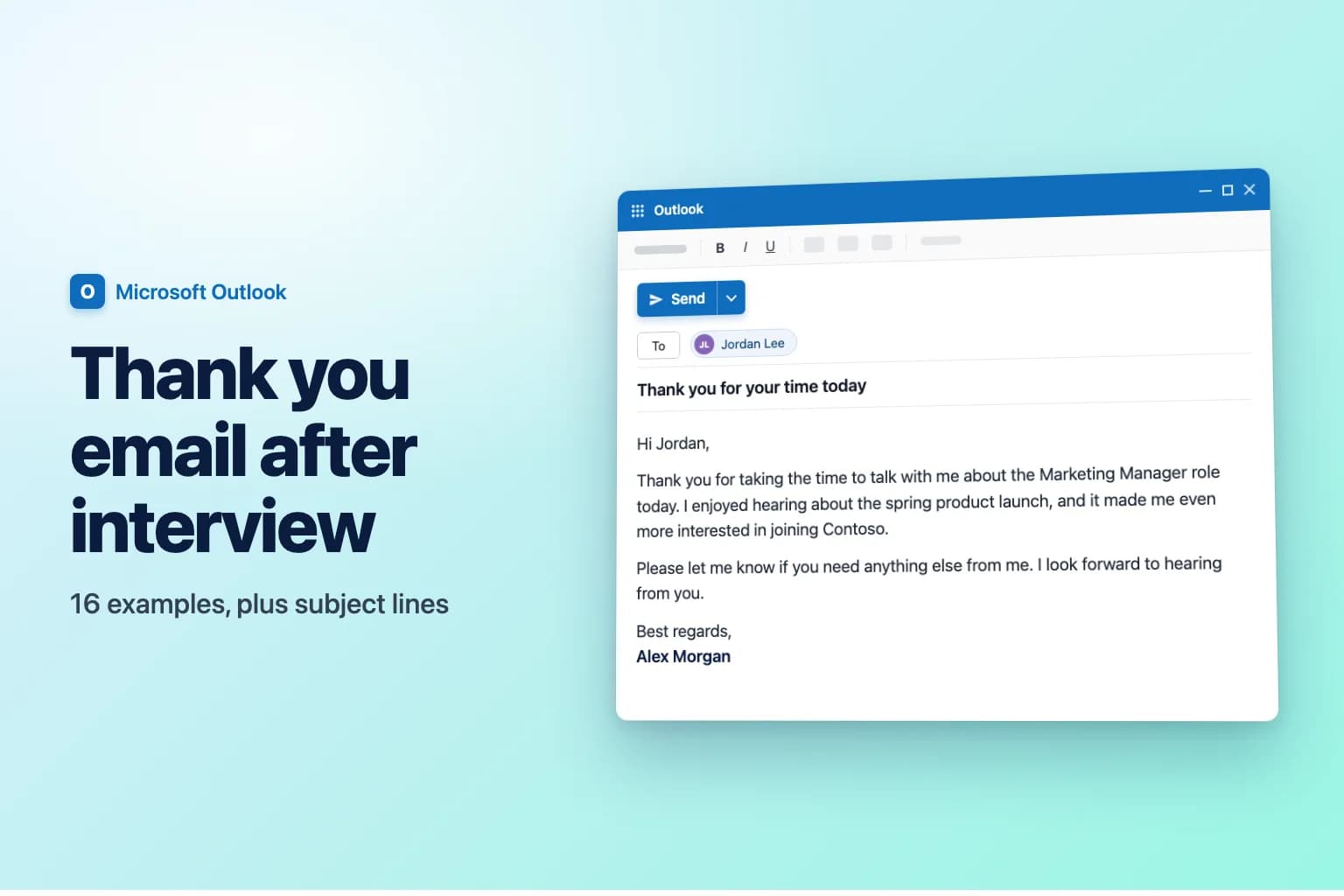
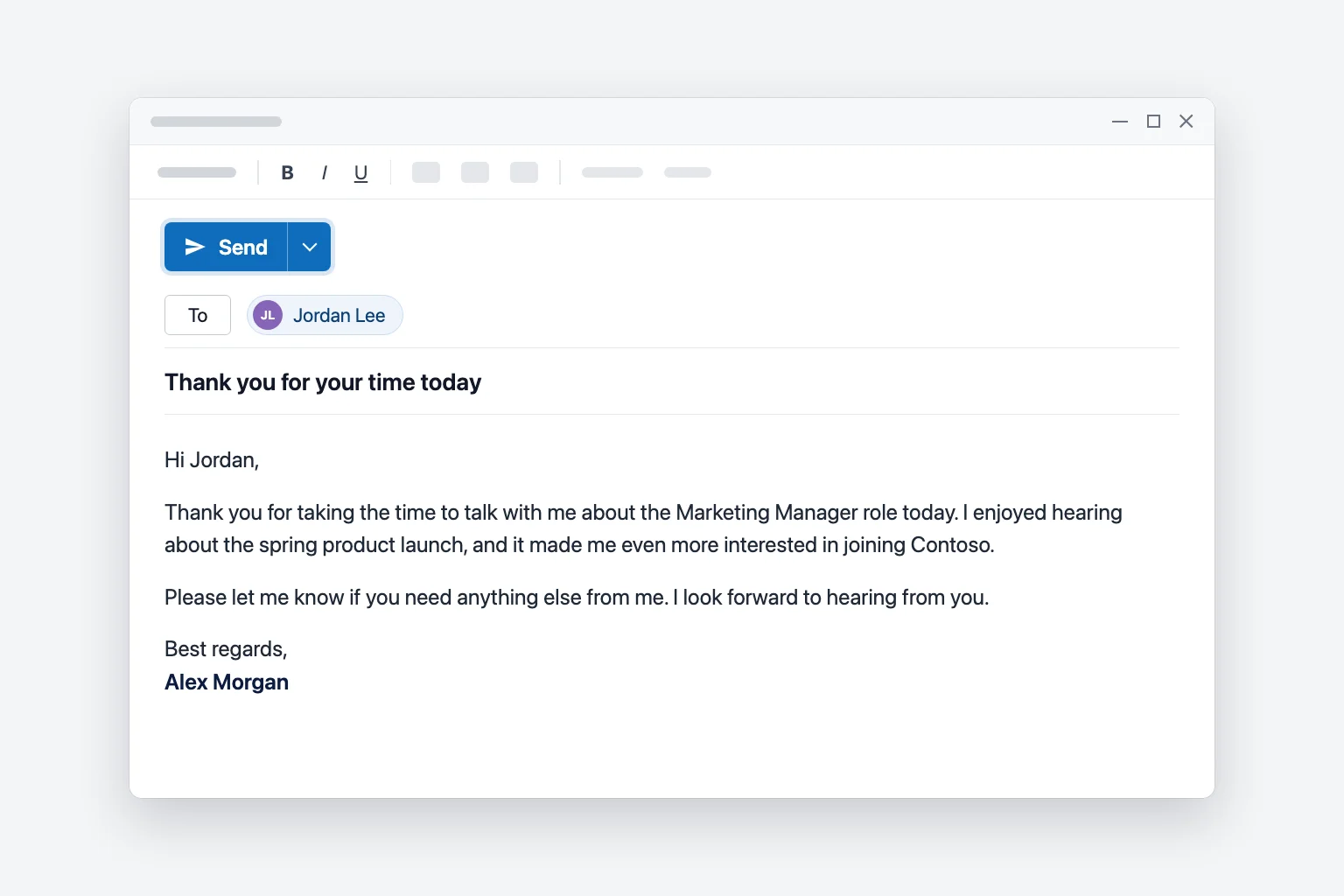
Subject: Thank you for your time today
Hi [Name],
Thank you for taking the time to talk with me about the [job title] role today. I enjoyed hearing about [one thing you discussed], and it made me even more interested in joining [Company].
Please let me know if you need anything else from me. I look forward to hearing from you.
Best regards,
[Your name]
Filled in and ready to send, the short version looks like this:
2. Standard thank you email (the full version)
Use it when: the interview went well and you want to remind them why you fit the role.
Subject: Thank you, [job title] interview
Hi [Name],
Thank you for meeting with me today about the [job title] position. I appreciated learning more about the team and how [Company] is approaching [project or goal they mentioned].
Our conversation about [specific topic] stayed with me. In my current role I [one relevant result or experience], and I would be glad to bring that experience to your team.
I am very interested in the role and happy to send anything else you need. Thank you again for your time.
Best regards,
[Your name]
[Phone number]
3. Thank you email after a phone interview
Use it when: you had a phone screen with a recruiter or hiring manager and want to reach the next round.
Subject: Thank you for the call today
Hi [Name],
Thank you for calling me today to talk about the [job title] role. It was helpful to hear how the position fits into [team or department], and what you shared about [detail from the call] confirmed that this is the kind of work I am looking for.
I would welcome the chance to continue the conversation in the next round. In the meantime, please let me know if I can send any further information.
Kind regards,
[Your name]
Which example fits your interview
| Your situation | Example |
|---|---|
| Any interview, and you want it short | 1 |
| It went well and you want to stand out | 2 |
| Phone interview or phone screen | 3 |
| Video interview | 4 |
| Second interview | 5 |
| Final interview | 6 |
| Several interviewers at once | 7 |
| You only have the recruiter's email address | 8 |
| You forgot to mention something | 9 |
| One of your answers went badly | 10 |
| They asked you to send something | 11 |
| Interview for a role inside your own company | 12 |
| Internship or first job | 13 |
| Career change | 14 |
| More than a day has already passed | 15 |
| You no longer want the job | 16 |
Thank you emails for every interview stage
4. Thank you email after a video interview
Use it when: you interviewed on a video call.
Subject: Thank you for today's conversation
Hi [Name],
Thank you for taking the time to meet with me by video today. Your description of [team, project or way of working] gave me a clear picture of what working at [Company] is like.
I was especially interested in [specific topic], because it is close to the work I did on [relevant project]. I would be excited to contribute to it.
Thank you again for your time. I look forward to the next steps.
Best regards,
[Your name]
5. Thank you email after a second interview
Use it when: you were invited back, met more of the team, or went deeper with the same person. Do not resend your first email: add something new.
Subject: Thank you for the second interview
Hi [Name],
Thank you for inviting me back to talk further about the [job title] role. Meeting [names or team] and going deeper into [topic] made me even more confident that this position is a good match.
After our discussion about [challenge they described], I kept thinking about how I would approach it. My first step would be [one short idea], building on what I did at [previous company or project].
I am excited about the possibility of joining [Company]. Please let me know if there is anything else I can provide.
Best regards,
[Your name]
6. Thank you email after a final interview
Use it when: this was the last round and the next message from them is the decision.
Subject: Thank you, and looking forward to next steps
Hi [Name],
Thank you for the time you and the team have given me throughout the interview process. Today's conversation about [topic] was a great way to finish it.
Each conversation has made me more certain that I want this role. I am confident I can [main contribution you would make], and I would be proud to do that at [Company].
You mentioned a decision by [date]. I will be available if any questions come up before then. Thank you again.
Best regards,
[Your name]
7. After a panel interview (one email per person)
Use it when: several people interviewed you together. Send each person a separate email and change the first paragraph for each one, because interviewers often compare notes.
Subject: Thank you for today's panel interview
Hi [Name],
Thank you for being part of my interview for the [job title] role today. I appreciated your questions about [topic this person raised], and your point about [their comment] gave me a better understanding of what the team needs.
Meeting the whole group made me even more interested in working with you. Please let me know if I can provide anything else.
Best regards,
[Your name]
8. To the recruiter who arranged the interview
Use it when: a recruiter or coordinator set everything up, or you do not have the interviewers' email addresses.
Subject: Thank you for arranging today's interview
Hi [Name],
Thank you for setting up my interview with [interviewer or team] today. The conversation went well from my side, and I am still very interested in the [job title] role.
Could you please pass my thanks on to [interviewer names]? I do not have their email addresses. I am happy to provide references or anything else the team needs for the next step.
Thanks again for your help,
[Your name]
Thank you emails for tricky situations
9. When you forgot to mention something
Use it when: you remembered a relevant project, skill or result after the interview ended.
Subject: Thank you, and one thing I did not mention
Hi [Name],
Thank you for talking with me about the [job title] role today. I enjoyed the conversation, especially the part about [topic].
One thing I did not get to mention: [experience, skill or result in one or two sentences]. Since you said [need they described], I thought it was worth sharing.
I remain very interested in the position and look forward to hearing from you.
Best regards,
[Your name]
10. When one of your answers went badly
Use it when: you gave a weak answer and now have a better one. Fix one answer only, keep it brief, and do not apologize at length.
Subject: Thank you, and a follow-up to your question
Hi [Name],
Thank you for your time today. I enjoyed learning more about the [job title] role and the team.
I have been thinking about your question on [topic], and I would like to give you a clearer answer than I did during the interview. [Your improved answer in two or three sentences.]
Thank you again for the conversation. I am very interested in the role and happy to discuss this further.
Best regards,
[Your name]
11. When they asked you to send something
Use it when: the interviewer asked for a work sample, a portfolio, references or your availability. Attach the file before you write the email, so you cannot forget it.
Subject: Thank you, and the [work sample] you asked for
Hi [Name],
Thank you for meeting with me today about the [job title] role. I enjoyed our conversation about [topic].
As promised, I have attached [the work sample, portfolio or reference list]. [One sentence on what it shows or where to start.]
Please let me know if you would like anything else. I look forward to hearing from you.
Best regards,
[Your name]
12. After an internal interview
Use it when: you applied for a role in your own company and the interviewer is a colleague or manager you already know.
Subject: Thank you for today's conversation
Hi [Name],
Thank you for taking the time to talk with me about the [job title] opening. Even though we already work together, I appreciated the chance to hear how you see the role and what the team needs over the next year.
I would be glad to bring what I have learned in [current team or role] to this position, especially [relevant strength or result].
Whatever the outcome, thank you for considering me.
Best regards,
[Your name]
13. After an internship or first job interview
Use it when: you are a student or recent graduate without much work experience to point to.
Subject: Thank you for the interview
Hi [Name],
Thank you for interviewing me for the [internship or job title] position today. I enjoyed learning about [project or team], and your advice about [something they shared] was very helpful.
I am eager to learn, and I believe my experience with [course, project or part-time job] has prepared me to contribute from the first week.
Thank you again for the opportunity. I look forward to hearing from you.
Sincerely,
[Your name]
14. When you are changing careers
Use it when: your background is in another field and the interviewer asked about the move.
Subject: Thank you for today's interview
Hi [Name],
Thank you for talking with me about the [job title] role, and for your open questions about my move from [previous field].
Our conversation confirmed that the skills I built in [previous field], especially [transferable skill], apply directly to [need they described]. I am also [course, certification or project you are working on] to close the remaining gaps.
I am excited about this change and about [Company] in particular. Thank you for considering me.
Best regards,
[Your name]
15. A late thank you email
Use it when: two or more days have passed. One short line about the delay is enough, then carry on as normal.
Subject: Thank you for the interview on [day]
Hi [Name],
I wanted to thank you for meeting with me on [day] about the [job title] role. I am sorry this note is a little late.
I have thought a lot about our conversation since then, particularly [topic], and I am still very interested in joining [Company].
Please let me know if there is anything else you need from me.
Best regards,
[Your name]
16. When you no longer want the job
Use it when: you decided the role is not right for you, or you accepted another offer. Send it quickly so they can move on with other candidates.
Subject: Thank you, and an update on my application
Hi [Name],
Thank you for taking the time to interview me for the [job title] position. I enjoyed meeting you and learning about [Company].
After careful thought, I have decided to withdraw my application because [short, neutral reason, for example: I have accepted another offer]. This was not an easy decision.
I appreciate your time and wish you and the team all the best. I hope we have the chance to work together in the future.
Best regards,
[Your name]
Thank you email subject lines
The subject only has to say what the email is, so keep it plain and short enough to read in full on a phone. Any of these works:
- Thank you for your time today
- Thank you for the interview
- Thank you, [job title] interview
- Thank you for the call today
- Thank you for the second interview
- Great speaking with you today
- Following up on our conversation
- Thank you from [Your name]
If the interview was arranged by email, the easiest option is to reply in that same thread. The subject is already there, and the interviewer sees right away who you are and which role it was.
Want more options for your exact message? Paste your draft into the free email subject line generator and it suggests five subject lines to choose from.
When to send a thank you email after an interview
Send it within 24 hours, and on the same day if you can. Hiring teams often compare candidates soon after the last interview, and your email should arrive before that conversation, not after it.
- Morning interview: send it that afternoon.
- Afternoon interview: send it that evening or first thing the next morning.
- Friday interview: send it on Friday. Do not wait until Monday.
- Several rounds: send a new email after each round, to the people you met in that round.
- Finished writing at midnight? Schedule it for the next morning instead. Here is how to schedule an email in Outlook and how to schedule an email in Gmail.
Give yourself at least an hour after the interview. An email that arrives five minutes after you leave reads like something written in advance, and the specific detail is what makes it work.
If you missed the 24 hours, send it anyway (example 15). A late thank you is better than none.
How to write a thank you email after an interview
Every example above follows the same five-part structure. Once you know it, you can write your own in a few minutes:
- Greeting. Use the name the interviewer used with you. If they introduced themselves by first name, "Hi [first name]," is right. In a formal setting, use their title and last name.
- Thanks. Thank them for their time and name the role, since they may be hiring for several.
- One specific detail. Mention something you actually talked about: a project, a challenge, a number, a piece of advice. This is the sentence that shows the email was written for them.
- Why you fit. Connect that detail to something you have done, in one or two sentences. Do not repeat your whole resume.
- Close. Say you are interested, offer to send anything else, and sign off with your full name.
Aim for 80 to 150 words. Match the tone of the interview: friendly if it was relaxed, more formal if it was not.
Mistakes to avoid in a thank you email
- The wrong name or company. It happens when you reuse an email from another application. Read the greeting, the company name and the job title one more time before sending.
- Typos. A spelling mistake in a five-sentence email stands out. Paste the text into the free grammar checker before you send it.
- The same email to every interviewer. If three people on a panel receive identical messages, it looks like a template. Change at least one sentence for each person.
- Too long. If it does not fit on a phone screen without much scrolling, cut it.
- Asking about salary, benefits or the decision. The thank you email is not the place. Save those questions for the recruiter or the offer stage.
- A missing attachment. If you promised a file, attach it first and write second.
- Sending a template unchanged. Every example here needs at least one detail that only you could write. Without it, the email says nothing.
- Following up too often. One thank you email per round. If you hear nothing, wait until the date they gave you, or about a week, before you ask for an update.
Frequently Asked Questions
Should you send a thank you email after an interview? Yes. It takes five minutes, many interviewers expect it, and it gives you one more chance to show interest and add a useful detail. It will rarely win the job alone, but it can separate you from a candidate who sent nothing.
How long should a thank you email after an interview be? About 80 to 150 words in three short paragraphs. A short thank you email of two paragraphs (example 1) is fine after a first call or a brief interview.
Do I send a thank you email to each interviewer? Yes, one separate email per person, each with a different detail. If you only have one address, write to that person and ask them to pass your thanks on to the others (example 8).
What if I do not have the interviewer's email address? Ask the recruiter or the person who scheduled the interview, or send your thanks through them. Do not guess an address.
Is an email better than a handwritten note? For most jobs, yes. An email arrives the same day, before the decision is made. You can send a card as well if it suits the company, but do not let it replace the email.
Should I send a thank you email after a phone interview? Yes. A phone screen is a real interview round, and the recruiter usually decides who moves forward. Keep it short (example 3).
What if nobody replies to my thank you email? That is normal, and it does not mean bad news. Many interviewers read the email and do not answer. Wait until the date they gave you, or about a week, then send one short follow-up asking about the timeline.
Draft your thank you email inside Outlook or Gmail
The examples give you the structure. The detail from your own interview is the part you have to add, and that is where most people get stuck. CoreGPT for Outlook drafts the email for you right inside Outlook: open the interview thread, tell it in one line what you want to say (for example, "thank Jordan for the interview, mention the launch plan, keep it short"), and edit the draft before you send. CoreGPT for Gmail does the same in Gmail. It's free to start.
 CoreGPT
Priya Shah
Re: Q4 launch timeline
Can we confirm the dates…
Marco Rossi
Contract renewal
Attached is the updated…
Support
Ticket #4821 resolved
Your request has been…
Emma Clark
Lunch on Thursday?
Are you free around…
Re: Q4 launch timeline
Priya Shah
Marketing needs final copy by Oct 28 if we keep the Nov 3 launch. Can engineering confirm the release candidate is on track?
Daniel Kim
RC is on track for Oct 30. QA needs two extra days for the payments flow, so Nov 3 is tight but possible.
Priya Shah
If QA slips, should we move the launch to Nov 5 instead?
Hi Priya, agreed. If QA needs the extra days, let’s move the launch to Nov 5 and keep Oct 28 for final copy. Thanks!
Try it: CoreGPT for Outlook
Related reading: